Trailcam
A meter for what is alive in your mix, not just what is loud. It is free, it never expires, and it never touches your audio.
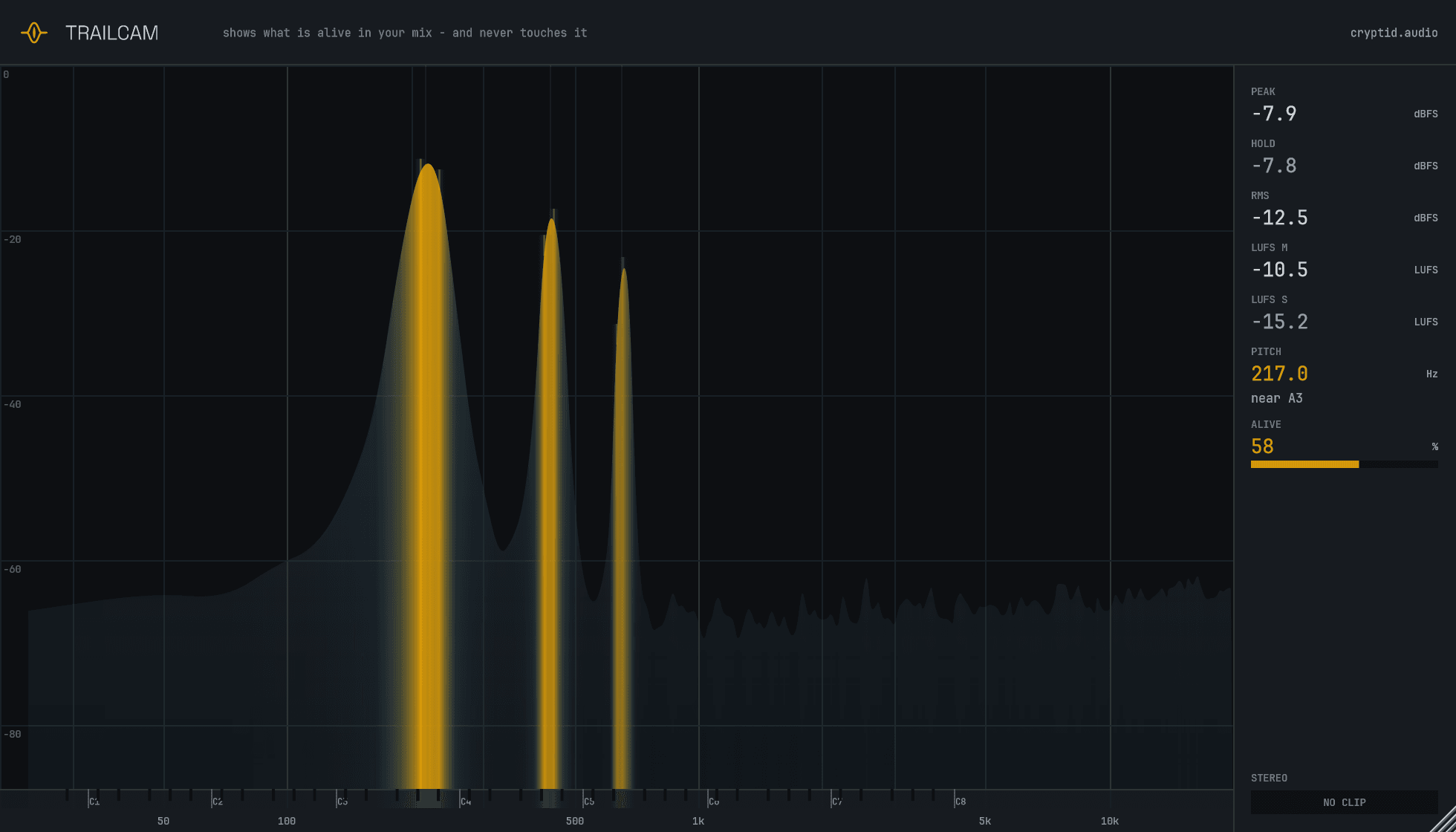
One held note — A3 with its first two harmonics, and hiss underneath. It is the plugin’s own test signal rather than music, rendered by the same automated test that checks the display draws anything at all. It is captured about a second in, so short-term loudness is still catching up.
Most spectrum analyzers show you what is loud. Trailcam shows you what is holding: the sustained, musical core of a note glows warm amber, while noise and transient energy stay dim and cool. It is the same analyzer that draws Aura’s display, on its own, with none of the processing.
What it shows. Peak in dBFS with a peak hold — a fast meter rather than a sample-by-sample one, so a click only a few samples wide reads lower than its true height, and a separate latch flags any sample that reaches full scale. RMS in dBFS. Momentary and short-term loudness in LUFS, K-weighted with smoothed windows rather than the standard’s exact ones: an approximation, not a certified meter, and there is no integrated reading. A pitch estimate in hertz with the nearest note name — a label for the region, not a tuner. It wants harmonics: a note with its overtones lands on the fundamental, while a bare sine with nothing above it commonly reads an octave or a twelfth low, and on a chord or a full mix it settles on one pitch that can sit well below anything actually sounding. And ALIVE: the share of the spectrum’s total level, 20 Hz to 20 kHz, sitting roughly where the display is glowing amber. It is a share, not a grade — one held tone reads high, hiss reads near zero, and a chord of close intervals reads lower than you would expect.
RMS, the spectrum, the pitch estimate and ALIVE are read from the left and right channels averaged to mono, so anything out of phase between them cancels; peak and loudness read both channels. Every number on the rail is calculated from the signal passing through, and nothing on the display moves unless the signal moved.
It does nothing to your sound. The buffer that arrives is the buffer that leaves, sample for sample, and Trailcam reports zero latency so no host delay-compensates a track because you put a meter on it. One automated test compares the output with a reference copy of the input at 44.1, 48 and 96 kHz, at block sizes from 16 to 2048 samples, mono and stereo, and requires them to be identical. A second requires the reported latency to be 0 at five sample rates from 44.1 to 192 kHz. pluginval, the standard plugin validator, passes this exact build at its highest strictness and reports the same zero.
Nothing to unlock. No licence key, no activation, no expiry, no phone-home, no nag screens and nothing held back. The only link in its window is a plain cryptid.audio in the header. 64-bit Windows 10 or 11, VST3 plus a Standalone app, mono and stereo tracks. There is no Mac version yet: the Mac port is in development for the paid plugins and Trailcam would follow it, and we are not going to guess a date. Free to use, including on work you sell; not free to redistribute — the same licence as our other plugins, minus the trial and the key.
The installer, straight from this site. No email address, no account, no checkout. It puts the VST3 in the standard Windows VST3 folder and installs the Standalone app alongside it. Windows 10 or 11, 64-bit, 1.0.2 — our plugins share one version line, so a first release starts at the number the rest are on.
The installer is not code-signed yet, so Windows SmartScreen warns before it runs: choose “More info”, then “Run anyway”. The install page says why, and what to check if your DAW does not list Trailcam after a rescan.
What happened to the question that was on this page. Until 6 November it asked whether anyone wanted Trailcam built. It said that if enough people put their name down we would build it, though not straight away, because the paid plugins came first until they had independent reviews behind them; and that if not enough did, we would say so here.
Neither condition was met. The test was stopped about a day after the page opened and the plugin was built anyway, before the sign-up count was read and before the paid plugins had independent reviews. So this is a decision, not a result: the question neither passed nor failed, and whether anyone wants a free Cryptid plugin is still unmeasured. When we did read the count, on 8 November, it was zero, from a test stopped after about a day: too short for zero to answer the question either way.
Why a free plugin was on the table at all: very few people find our store, and a free meter is one way they might. That part is also still unlearned. We said we would rather build what people asked for than what we assumed. This one we assumed.
If you want the processing as well, Aura is the channel strip this analyzer comes from. Its display also carries integrated loudness, loudness range and true peak, which Trailcam does not, and its 14-day trial is the whole plugin.